Low-, Mid-, or High-Pressure Misting System: How to Choose
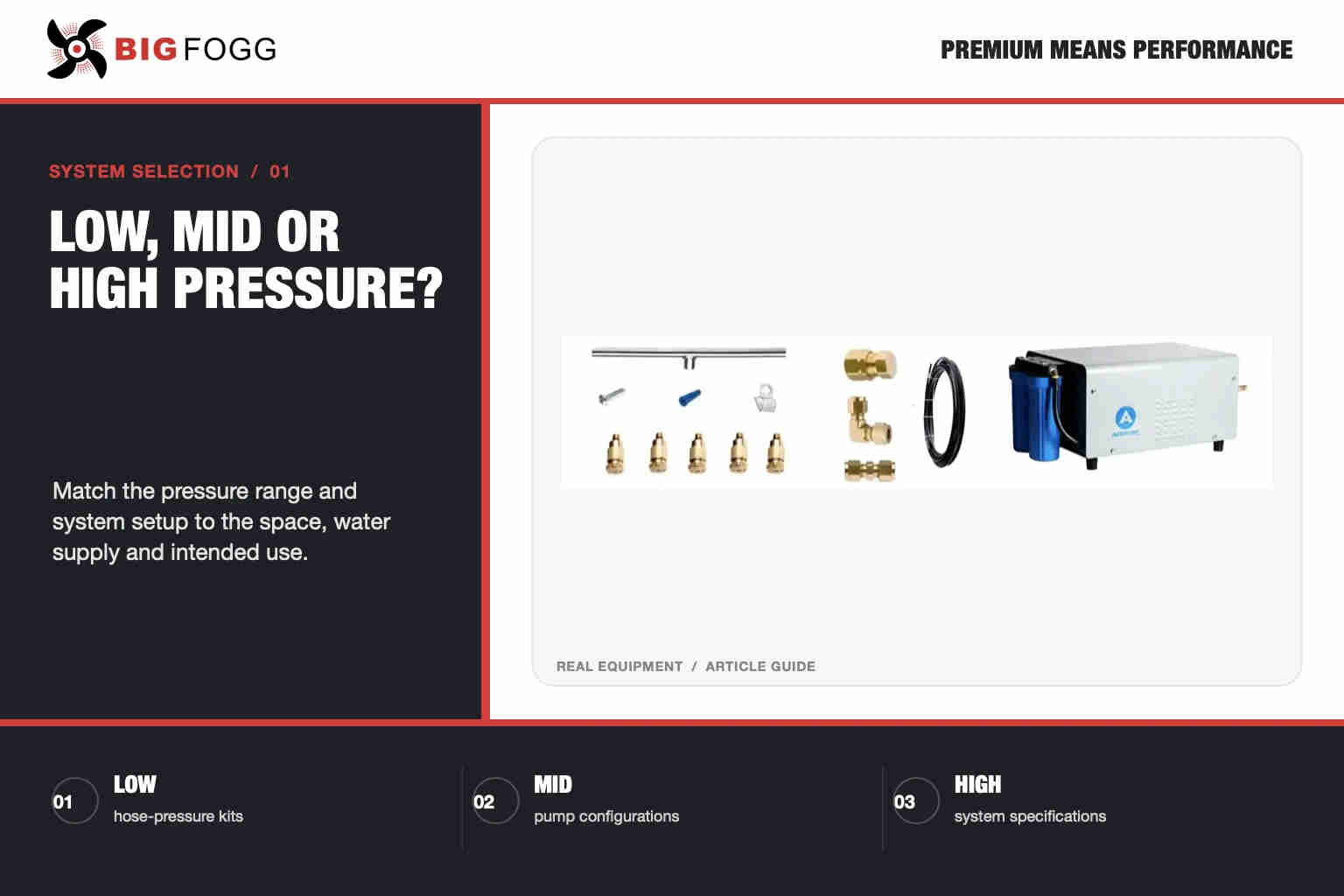
Quick answer: Choose a misting pressure range by matching the system to the site, desired spray, water and power access, and operating schedule. BigFogg offers hose-pressure low-pressure kits, mid-pressure products listed at 160–180 or 300 psi, and high-pressure systems commonly built around 1,000 psi. These are BigFogg product ranges, not universal definitions; compare the specifications of the exact system you are considering.
In This Article
- Compare the pressure options
- Match the system to the site
- What to ask before you choose
- Compare the complete operating specification
- Frequently asked questions
- Compare a complete system proposal
Compare the pressure options
| BigFogg option | How it is described on BigFogg’s site | Planning considerations |
|---|---|---|
| Low pressure | Uses standard hose pressure without a separate misting pump | Larger droplets may remain visible longer; check water supply, spray pattern and nearby surfaces. |
| Mid pressure | Product lines include 160–180 psi and 300 psi pumps | Review the exact pump, tubing, nozzle configuration and the conditions the system is meant to serve. |
| High pressure | BigFogg systems commonly use a 1,000 psi pump | Requires a compatible pump, line, fittings, filtration and electrical supply; plan installation and service access. |
Pressure alone does not determine how comfortable a space will feel. Temperature, humidity, airflow, wind, system layout, nozzle condition and water quality also affect the result. Higher pressure is not a guarantee that every surface will remain dry.
BigFogg’s low-pressure systems, mid-pressure systems and high-pressure systems show the product configurations currently available. Check each product page for current specifications before ordering.
Match the system to the site
Start with the area people use, whether it is open or enclosed, and what needs to stay dry. A small patio with a hose connection has different requirements from a restaurant perimeter line, a manufacturing work zone or a sports sideline. Note typical heat and humidity, wind exposure, operating hours, water quality, electrical service and whether the layout is permanent or temporary.
Use this list to narrow the conversation with a supplier:
- Water and power: Identify the available supply and outlet locations, including circuit requirements for the proposed pump.
- Coverage: Mark the occupied zone, mounting surfaces, paths, doors and equipment.
- Moisture tolerance: Flag furniture, food service, electronics, flooring, plants or products that should not be wetted.
- Operation: Describe how often the system will run and who will start, stop and maintain it.
- Expansion: Say whether you may add lines, nozzles or zones later; the pump must suit the planned configuration.
What to ask before you choose
Ask for the operating pressure, pump capacity and intended duty, compatible line and nozzle options, filtration requirements, utility specifications, maintenance schedule and warranty. Request a layout recommendation based on your measurements rather than estimating the number of nozzles from area alone. BigFogg’s misting technology FAQs and misting system options are useful starting points; the contact team can review a site plan.
Compare the complete operating specification
Treat the pressure range as one part of the system description. Before comparing two proposals, confirm they use compatible nozzle types and line arrangements and are intended to serve similar operating conditions. Ask the supplier to state the operating pressure for the proposed configuration, not just a headline pump rating, and to explain the expected spray behavior for the selected nozzles.
Your comparison should also cover:
- Pump capacity and the number and type of nozzles in the design.
- Filtration and water-quality requirements for the available supply.
- Electrical connection, duty expectations, controls and service access.
- Materials, mounting, installation scope and maintenance instructions.
BigFogg’s pump-selection guide explains why pressure and flow need to be matched to the full layout. If you are still at the site-planning stage, use the misting system layout checklist to collect the details a designer needs.
Compare a complete system proposal
A pressure label is only one line in a system proposal. Ask each supplier to describe the intended operating pressure, pump capacity for the proposed configuration, nozzle type and count, filtration, and the conditions the system is designed to serve. Two proposals are easier to compare when both are based on the same site plan and operating schedule.
Before choosing, make sure the quote identifies which components are included and which site work is outside its scope. Confirm the electrical supply, water connection, mounting approach, controls, service access, and maintenance instructions for the exact model. If the system may expand later, ask what changes would require a different pump or redesign; do not assume that adding nozzles is a simple extension.
Use BigFogg’s misting pump selection guide to understand which pump details to request, then pair it with the system layout planning guide before asking for a site-specific recommendation. The misting pump collection shows the current product range; confirm exact specifications on the listing for the model under consideration.
Frequently Asked Questions
What is the difference between low-, mid- and high-pressure misting?
The systems use different pump and nozzle configurations. BigFogg lists hose-pressure low-pressure kits, mid-pressure options at 160–180 or 300 psi, and high-pressure systems generally configured around 1,000 psi. Compare the exact product specifications.
Does higher pressure always mean better cooling?
Not automatically. Site conditions, airflow, humidity, wind, nozzle selection and placement affect performance. Choose the system for the application and ask for a site-specific recommendation.
Which system needs electricity?
BigFogg’s low-pressure kits use standard hose pressure and do not require a separate pump. Mid- and high-pressure pump models need electrical power; check the product’s voltage and circuit requirements.
Can I add more nozzles to a system later?
Only if the pump and configuration support the added flow and line. Confirm expansion limits with BigFogg before changing the system.
Does a psi rating tell me exactly how fine the mist will be?
No. Pressure is one factor. Nozzle design, flow, filtration and the complete configuration also affect the spray. Check the specifications for the exact system and nozzle combination.
Related Resources
- Low-pressure misting systems
- Mid-pressure misting systems
- Misting pumps
- Contact BigFogg for system guidance
About BigFogg
BigFogg has supplied misting systems and fans since 1999 for sports, commercial, industrial and residential applications. Explore BigFogg misting systems or contact the team.